The Khartoum Process
The Khartoum Process is a platform for political cooperation amongst the countries along the migration route between the Horn of Africa and Europe.
The Khartoum Process was set up on 28 November 2014, at the Ministerial Conference held in Rome, Italy.
Also known as the EU-Horn of Africa Migration Route Initiative, the inter-continental consultation framework aims at:
- establishing a continuous dialogue for enhanced cooperation on migration and mobility
- identifying and implementing concrete projects to address trafficking in human beings and the smuggling of migrants
- giving a new impetus to the regional collaboration between countries of origin, transit and destination regarding the migration route between the Horn of Africa and Europe.
The objectives of the Khartoum Process
The Dialogue seeks to create:

a common understanding of human trafficking and smuggling of migrants


Strategic Framework
During the 2nd Ministerial Conference held in Cairo on 9 April 2025, the Cairo Declaration and Cairo Action Plan were officially adopted, setting out the strategic framework for the Khartoum Process going forward. These documents build upon the foundational principles established by the Rome Declaration of 2014 and the five domains of the Joint Valletta Action Plan of 2015, reinforcing commitments to addressing migration challenges collaboratively.
JOINT VALLETTA ACTION PLAN (JVAP)
In November 2015, a Summit on Migration took place in Valletta, Malta. European and African Heads of State and Government gathered around the objective to strengthen cooperation between the two continents.
In a spirit of solidarity, partnership and shared responsibility, two texts were adopted:
- A political declaration underlining the concern of participating States and organisations regarding humanitarian consequences of irregular migration and their commitment towards the improvement of the management of migration flows.
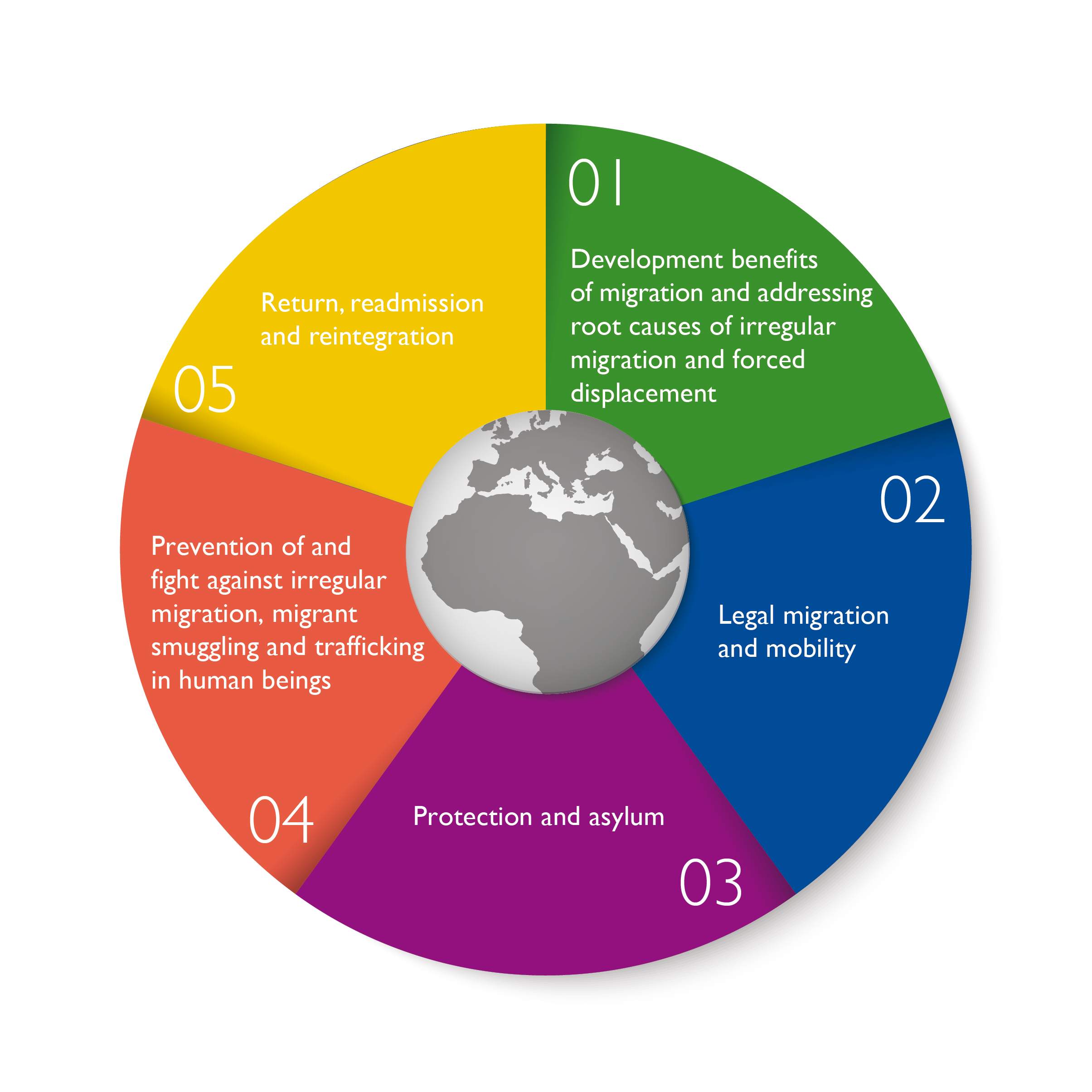
- The Joint Valletta Action Plan (JVAP), which lays down a series of priorities aiming at supporting Valletta Partners with the enhancement of migration governance between Europe and Africa. The JVAP became the regional framework to address migration policy. It is built around five domains, each addressing a specific area.
The five domains of the Joint Valletta Action Plan
The Joint Valletta Action Plan Follow up
The Khartoum Process and the Rabat Process were identified as suitable existing mechanisms to monitor the implementation of the JVAP. Focal Points from these regional migration dialogues covering Europe, North, West, Central and East Africa, became JVAP Partners. The JVAP Follow-up is a stakeholder-driven process, JVAP Focal Points demonstrating ownership by providing as much information as possible on their initiatives to populate a Database. This reporting enables decision makers to develop fact-based migration policies and share good practices.
For more information on the JVAP Follow-up and its tools, please refer to the dedicated reference portal: www.jvapfollowup.org
Actors and Governance



The following countries are signatories of the Declaration of the Ministerial Conference of the Khartoum Process, also known as the Rome Declaration:
Austria, Belgium, Bulgaria, Croatia, Cyprus, Czech Republic, Denmark, Djibouti, Egypt, Eritrea, Estonia, Ethiopia, Finland, France, Germany, Greece, Hungary, Ireland, Italy, Kenya, Latvia, Lithuania, Luxembourg, Malta, The Netherlands, Poland, Portugal, Romania, Slovakia, Slovenia, Somalia, South Sudan, Spain, Sudan, Sweden, Tunisia and the United Kingdom.
Since this Declaration, Libya was also invited as a Member of the Khartoum Process upon the establishment of a Government of National Accord, and Norway, Switzerland and Uganda have also become Members of the Process.
In 2025, Eritrea communicated its intention to withdraw from the Khartoum Process, with its withdrawal subsequently validated at the 14th Senior Officials' Meeting held in April 2026. In 2026, the United Kingdom also rejoined the Khartoum Process, following its withdrawal from the Process in the context of the United Kingdom's departure from the European Union on 31 January 2020.
Key stakeholders
Click here to view a governance chart
Steering Committee: The Khartoum Process is led by a Steering Committee currently comprised of:
- six EU Member States (Italy, Finland, France, Germany, Sweden, The Netherlands)
- five African partner countries (Egypt, Ethiopia, South Sudan, Sudan, Uganda)
- the European Commission, the European External Action Service (EEAS) and the African Union Commission.
Following Eritrea's withdrawal from the Khartoum Process, a procedure has been launched to fill the vacant Steering Committee seat with another African Partner Country, with a view to maintaining balanced African–European representation, ensuring effective governance, and further strengthening the role of African partners in the strategic orientation of the Process.
Chair: The current Chair of the Khartoum Process is Uganda.
Secretariat: The Secretariat provides day to day administrative assistance to the Khartoum Process, including the preparations of the meetings of the Steering Committee and of Senior Officials Meetings. The Secretariat acts on instructions from the Chair and Steering Committee and is jointly managed by the African Union Commission and the European Commission, with technical and logistical assistance provided by ICMPD through the Support Programme of the Africa-EU Migration and Mobility Dialogue (MMD).
ICMPD supports the Khartoum Process Secretariat by:
- providing logistical and technical assistance in support of the implementation of activities;
- providing background research, data collection and analysis for the preparation of tasks and activities;
- providing coordination to ensure coherence within and across the MMD components, especially through the MMD Dialogues (Continental Dialogue, Khartoum Process and Rabat Process).
Initiatives
The Khartoum Process is a regional dialogue for cooperation among the countries along the migration route between the Horn of Africa and Europe. The EU provides financial assistance to support the organisation of core events (i.e. Steering Committees, Senior Officials’ Meetings and Thematic Meetings) and the participation for all of the African members of the Khartoum Process. Additionally, several initiatives promote the implementation of the main objectives of the Khartoum Process.
Below are some examples of ongoing regional initiatives, which aim at supporting the Khartoum Process priorities and objectives, as charted by the Rome Declaration.